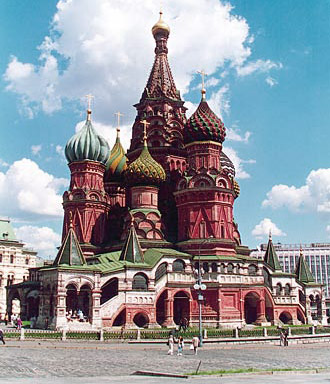
 We now visited the singular Church of St. Basil said to have been constructed for one of the Emperors who, after it was finished, tore out the eyes of the artist in order that he might not build another similar for any other monarch. It is a singular [47] building composed of several distinct chapels so arranged that services can be performed in them all at the same time, without the one disturbing the other.
Showing posts with label Moscow. Show all posts
Showing posts with label Moscow. Show all posts
Friday, September 30, 2011
Church of St. Basil
We now visited the singular Church of St. Basil said to have been constructed for one of the Emperors who, after it was finished, tore out the eyes of the artist in order that he might not build another similar for any other monarch. It is a singular [47] building composed of several distinct chapels so arranged that services can be performed in them all at the same time, without the one disturbing the other.
Sunday, September 25, 2011

 |
| Fedor Alekseev and his pupils. The Foundling Hospital in Moscow.1800-1802. Watercolour on paper. The Hermitage, St. Petersburg, Russia. |
Saturday, September 24, 2011
After leaving the interior of the Kremlin we passed by the Spaskoi [sic] Gate or Holy Gate, under which no person can pass without uncovering the head, and the Russians are so particular with regard to this that it is said, no bribe would induce one of them to pass under this gate with his hat on, were he not compelled to doff it by the Sentinel who stands always by--- The reason of its great sanctity, I cannot find. ‘Tis dedicated to some saint I believe.
 |
| Spassky Gate, Kremlin |
Friday, September 23, 2011
Born to Command
 We were shown in another room the saddles of Catherine II. We had seen in another room a portrait of this singular woman, in her favorite manner of appearing before her guards, mounted and dressed as a man, and really she looked as if she were born to command. Her saddles were completely covered with jewels and certainly very rich, but do not now seem so much so, since I have seen the magnificent ones presented by the father to the Emperor. Below we were shown several old state carriages & sleighs made at different times and in different countries, driven in things they [covered], almost like a parlor with sofas, mirrors &c within, and requiring some two dozen horses to draw them. In still another room we were shown the model of a building which Catherine II intended once to have [43] enclosed the whole of the Kremlin with—which project however she abandoned as man others of the same kind, well, perhaps for her purse, as it certainly was for the beauty of Moscow. It was a great piece of work and if carried out according to the model must have cost an immense amount of money.
 Wednesday, August 31, 2011
More on Siberian-bound convicts; Rev. Baird describes their crimes
 |
| Rev. Robert Baird, temperance campaigner |
Thursday, August 25, 2011
Convicts destined for Siberia
 Turning from our view of the city & the thoughts occasioned by it, of its former history, we [28] passed a short distance to the right to a building guarded by [Sentinels?], not looking much like a prison though strongly barred with iron. We arrived a few moments before the prisoners were brought out, and leaving our carriage, stationed ourselves before the main gate of the building in front of a number of troops formed in a square waiting for the appearance & purpose of conducting & guarding the Convicts. In a few moments, the gate was opened and we heard the voice of the officer on duty call out a name, and out stepped one of the unfortunate beings destined to spend the remainder of his days as a prisoner in Siberia. He was dressed as well as his fellows in the Convict’s dress of a mixed home-spun cloth, making a cloak & pants and a pair of boots. One half of his head [29] was shaved making his appearance singular indeed, whilst the other half of his head was, au naturel. He had an iron chain fastened to either ancle, and kept suspended, (so as not to interfere with his walking) by a belt tied around his waist. In this manner were some eighty-odd of these beings dressed preparatory to their weary journey from Moscow. Amongst these we now and then saw a female, some as convicts and others following their husbands to their place of Banishment. In front of the band ranged out in order, stood an old man with a plate in his hand collecting some small favors from the few spectators and officers standing about .The gate was now opened wide and out drove some half dozen wagons with luggage and those convicts who were too [30] old or too infirm to walk this six week journey. Here and there you could see a little baby in the arms of its mother, unconscious of course of its destination & future life. There was an old woman in one of the wagons whose countenance I think I shall never forget. She must have been near seventy years of age as dark as a Bohemian who was sitting beside her, and as she left the gates of the prison, her face expressed more than words could ever do; before her was an old man probably her husband and she was casting her lot still with him..
 Napoleon's Moscow
 One Evening at Moscow we took a short drive out on the road by which Napoleon entered the City. There is an Eminence at a short distance from the City, which [27] would shut out the view of Moscow from one approaching it from the opposite side. Was this that the great personification of Ambition, of good & bad deeds, after leading his weary soldiers through the snows of Russia, harassed on all sides by the waiting Cossacks, first saw the end of his journey, and how taking up a handful of the Earth, turned to his followers and cheered them wit the words which in his mouth seemed almost equivalent to Victory “Voici la terre de Moscou.” A few days afterwards and this great army left the place of their destination, a broken band and Napoleon wended his way to Paris, his confidence in his Omnipotence somewhat reduced from the place where he put it----
 Monday, August 15, 2011
Moscow truly foreign--the city after the fire of 1812
 |
| The burning of Moscow |
Thursday, August 11, 2011
The view of Moscow from Sparrow Hills (Воробьёвы го́ры)
 |
| View of Moscow from Sparrow Hills - Ivan Aivazovsky, 1848 |
Monday, August 8, 2011
The Greek Church

Friday, August 5, 2011
Preparing for Moscow
 We have now been hesitating for some time as regards taking a trip to Moscow, and have now finally concluded on starting immediately hoping to be able to return in time to witness the Entry of his Majesty [Emperor Nicholas I] into the Capital, but it is so undecided and he is so fond of taking the people by surprise, that no one knows when it will take place, and it is useless for us to wait much longer, as the season [15] is getting to be so late, that if deferred we should be obliged to give up the trip altogether. Orders have been given by the Police to every household to keep themselves in readiness for an illumination at any moment. Have been to the Chancery Office where we were again examined as usual, and given a paper allowing us by presenting it at the Police office, to obtain a fresh passport for Moscow, presented ourselves at the Police Office General, and after again answering all the questions once again, and paying twenty-five paper roubles, &c, about five dollars. We obtained a pass for Moscow, the Police retaining our original Passports until we may leave the Empire. Four of us in Company (Americans) obtained a Diligence and guard and at 2 o’clock P.M. of Wednesday 16 Sep we started for the city of Moscow. The road is the only good one in all Russia, being McAdamized its entire length which is here measured by Versts, the Verst being equal to about ¾ of a Mile English. [16] The distance between the cities is some 670 Versts making about 500 miles, and this was to be accomplished without our stopping at all on the road excepting for Breakfast & Dinner.
Subscribe to:
Posts (Atom)