Showing posts with label Leipzig. Show all posts

Sunday, November 20, 2011

Art in Dresden


Our ride from Leipzig on the Rail Road was of about four hours, to Dresden, the capital of Saxony and considered beautiful, principally [72] from its environs.  It is very pleasantly situated on the Elbe, which [is] nice somewhat farther to the South—but initially, it has little or no beauty at all, the Palace perhaps the largest in Extent in Europe, and its other publick buildings, being not handsome, not to say remarkably plain.  It is however much visited by Strangers, on a/c of its galleries &c. and per the fact of the German spoken here more purely than in any other city.  Miserable weather still, which has followed us all the way from Russia. 

I think I recognize these guys...
Saint Mary Magdalen
by Pompeo Batoni
(destroyed during WWII)
Found Williams and  [Astor?] here both studying German.  Visited firstly the Gallery of Pictures considered on the whole the finest out of Italy, and really in viewing it I could almost imagine myself again in Rome or Florence.  The pictures here the most celebrated, and really magnificent, are Raphael’s “Madonna del Sisto” and Correggio’s Recumbent Magdalene.  (I never attempt describing a picture [73] from inability but there are some that I can never forget).  There was another Magdalene hanging near to Correggio’s which I must say pleased me nearly if not quite as much as his—by Pompejo Geronimeo [Girolamo] Battone [Batoni].). There were several fine Titian’s, & Spagnolettos, and the Dutch and Flemish school very well represented.  In one of the first rooms was a small painting of Hagar going into the desert, most beautiful—by whom I know not, as soft as a miniature and one other that particularly pleased me, of Eve presenting the apple to Adam.

Tuesday, November 8, 2011

Dr. Faust's wine bar and a Leipzig Exposition

Entrance to Auerbach's Keller, Leipzig
Passed in our short ramble the cellar in which Göthe lays the scene of Dr. Faust’s pranks—and said also to be the one in which [66] he himself frequently shrank at the carousing of his fellow students.

There being nothing of particular interest in the town to visit we walked into an Exposition, or kind of Mechanic Fair, where we found a small but really very fine collection of the diff[erent] specimens of Saxon manufacture, for all that I could see as good as English or Yankee--.  

Sunday, November 6, 2011

Leipzig--Strange Roofs

The weather was so unpleasant where we were in Berlin that we could not make one or two excursions that we should have liked to viz to Potzdam.  We passed through it in the evening on our way to Leipzig, and could gain but a passing view of its many fine palaces and other buildings.  Stopped for breakfast on our journey at Wittenberg, still a fine looking old town, and [65] interesting in being the birth-place of the great reformation, a tree is shown outside the city where Luther publicly burned the Bull of Leo, excommunicating himself from the Holy Church.

The buildings of Leipzig are most singular in their foundation, in height  almost equal to those of the old town of Eroinbró[?] – but their peculiarity consists in the shape of their roofs and thewondoes in them.  The3 roofs are built, running up to a point and often equalin height to the remainder of the building, having generall three or four tiers of windows projecting from it, and now and then a small steeple not on the summit, but coming out of the roof itself—and these stories (upper) are all let out as the other apartments of the houses.

The River Elster at Leipzig


On entering the city we crossed the great battlefield, where nearly four hundred thousand men met in [64] combat, and Napoleon received one of his first great defeats.  The house at which we stopped to have our passports arranged still bears, in the many bullets and balls in its walls, evidence of the proximity of the scene of battle.  We passed over the bridge in entering the city which by being prematurely destroyed caused the capture and death of so many of Napoleons followers.  There is a small footbridge leading near to the Elster, over which ‘tis said that Napoleon was obliged to cross, first changing his now well known cap for that of one of his soldiers.  

Sunday, October 30, 2011

Tomb of the Gallant Poniatowski


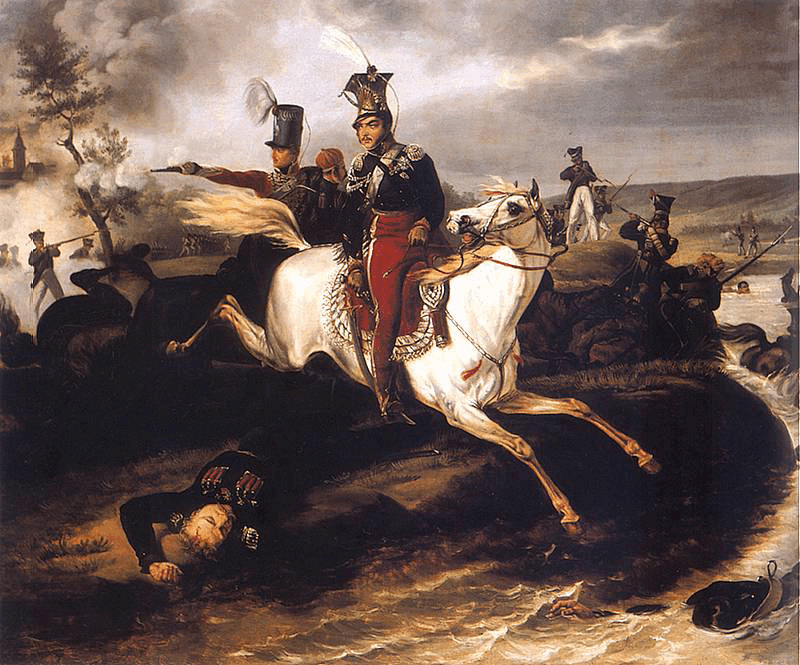
January Suchodolski, Death of Josef Poniatowski
Monument to Poniatowski, 1834
(destroyed by the Germans, 1939)
After visiting all of any great interest to us who had already visited the galleries and curiosities of Italy, we took our seats in the Schnell Post for Leipzig on Monday evening at 8 o’clock and completed our journey to that city in some twenty hours, arriving as our fortune has now been for some time past, in very indifferent weather.  After dining, we took a valet du place, and walked out to visit the tomb, and scene of the death of the gallant Poniatowski.  The tomb stands in a private garden near to the spot where his bodoy was found.  There is a small (species of) temple in the Garden containing a small monument by Thorwaldsen, and several miniaturies of the noble nephew of Stanislaus of Poland.  The temple has the simple word “Laribus” over the portal.  In another part of the grounds stands a plain, stone sarcophagus, with the name of Poniatowski upon it, wih the Polish Eagles, at each corner, and his own [63] coat of arms.  At some short distance from the tomb we came to that spot where his body was found, the river (Elster) is scarcely broader than a canal, and without taking into consideration his wounded state, and the choked up condition of the river, one would think that a child could scarcely have met his death there.  A stone monument is placed at the outlet of a pathway going through a fine grave in the immediate vicinity, to mark the spot which he passed after having crossed the Pleisse, and left to take the leap which caused his death.  Tis said that the two men who found his body some days after the battle are still living in the city.  Several orders and rings were found upon him, which alone positively certified that the body was that of the gallant Pole.