 We had now but one sight to look at, when we should be glad and ready to leave the country having been really so bothered by the Police what we began to get out of humour. Thus our last visit was to the mining corps, and the museum of minerals attached to it. The whole is indeed a very large fine looking building, and is considered as being a collection of minerals not surpassed in their kind in Europe. The mines, are fac-similes of the different mines of Russia and the Urals generally, all under ground and made with great care and exactitude. It gave us a very good idea of Siberia and other places, and the [49] the manner in which the convicts labor there.
Friday, September 30, 2011
Museum of Mines
We had now but one sight to look at, when we should be glad and ready to leave the country having been really so bothered by the Police what we began to get out of humour. Thus our last visit was to the mining corps, and the museum of minerals attached to it. The whole is indeed a very large fine looking building, and is considered as being a collection of minerals not surpassed in their kind in Europe. The mines, are fac-similes of the different mines of Russia and the Urals generally, all under ground and made with great care and exactitude. It gave us a very good idea of Siberia and other places, and the [49] the manner in which the convicts labor there.
Return to St. Petersburg
After taking another drive around the city we concluded to start again for St. Petersburg hoping to reach it in time to see the Entrée of the Royal Family (our passports for this once we were able to have arranged by a Valet—Duplace). We again started in the same conveyance, and after rather a shorter drive than before, reached the city, and learned that the Fête had taken place in our absence, the Emperor as usual only giving the people one days warning. I myself was in most excruciating agony on my arrival from a rheumatism in my left shoulder, that came upon me suddenly in a few hours and luckily passed off in a day or two. The climate is worse than any other that I have ever heard of, such sudden changes.______ Now we were again obliged [48] to again repeat the ceremony with regard to our passports, and to show the papers in which we had advertised ourselves for nine days (9). We obtained a Russian pass for Hamburg and had some difficulty in getting back our original passports. A piece of money settled that however.
Church of St. Basil
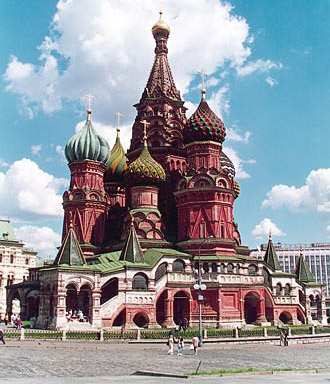 We now visited the singular Church of St. Basil said to have been constructed for one of the Emperors who, after it was finished, tore out the eyes of the artist in order that he might not build another similar for any other monarch. It is a singular [47] building composed of several distinct chapels so arranged that services can be performed in them all at the same time, without the one disturbing the other.
Sunday, September 25, 2011

 |
| Fedor Alekseev and his pupils. The Foundling Hospital in Moscow.1800-1802. Watercolour on paper. The Hermitage, St. Petersburg, Russia. |
Saturday, September 24, 2011
After leaving the interior of the Kremlin we passed by the Spaskoi [sic] Gate or Holy Gate, under which no person can pass without uncovering the head, and the Russians are so particular with regard to this that it is said, no bribe would induce one of them to pass under this gate with his hat on, were he not compelled to doff it by the Sentinel who stands always by--- The reason of its great sanctity, I cannot find. ‘Tis dedicated to some saint I believe.
 |
| Spassky Gate, Kremlin |
Friday, September 23, 2011
Born to Command
 We were shown in another room the saddles of Catherine II. We had seen in another room a portrait of this singular woman, in her favorite manner of appearing before her guards, mounted and dressed as a man, and really she looked as if she were born to command. Her saddles were completely covered with jewels and certainly very rich, but do not now seem so much so, since I have seen the magnificent ones presented by the father to the Emperor. Below we were shown several old state carriages & sleighs made at different times and in different countries, driven in things they [covered], almost like a parlor with sofas, mirrors &c within, and requiring some two dozen horses to draw them. In still another room we were shown the model of a building which Catherine II intended once to have [43] enclosed the whole of the Kremlin with—which project however she abandoned as man others of the same kind, well, perhaps for her purse, as it certainly was for the beauty of Moscow. It was a great piece of work and if carried out according to the model must have cost an immense amount of money.
Subscribe to:
Posts (Atom)