 |
| David Leavitt by Samuel Lovett Waldo Brooklyn Museum of Art |
Monday, October 3, 2011
David Leavitt, Sheldon's father

Fête for Princess Marie of Hesse and Prince Alexander; checking out at customs
 |
| Wedding of Grand Prince Alexander and Princess Marie of Hesse (Maria Alexandrovna) |
The whole city had been topsy-turvy for some time past, with sham fights, taking the citadel near the Hermitage fete all for the amusement of L’affiancée of the Grand Duke, Prince Royal—the fact is, the citizens must give up every thing to military movement. The bridges across the Neva are removed and they must cross in small boats. The squares are filled with Cossacks, cannon fire, and all must keep their windows open, if they do not wish them broken bvy the cannon. Military life is all in fact. My books I had the good fortune to retrieve from the Customs House, but my pistols were not delivered up, until the moment we sailed (midnight Oct 4.) and then were brought down by a soldier to Cronstadt some 20 miles from the city. Thus I was forced to pay the duty of Six silver rubles a pound on them nearly 5 dollars a pound.
Friday, September 30, 2011
Museum of Mines
 We had now but one sight to look at, when we should be glad and ready to leave the country having been really so bothered by the Police what we began to get out of humour. Thus our last visit was to the mining corps, and the museum of minerals attached to it. The whole is indeed a very large fine looking building, and is considered as being a collection of minerals not surpassed in their kind in Europe. The mines, are fac-similes of the different mines of Russia and the Urals generally, all under ground and made with great care and exactitude. It gave us a very good idea of Siberia and other places, and the [49] the manner in which the convicts labor there.
Return to St. Petersburg
After taking another drive around the city we concluded to start again for St. Petersburg hoping to reach it in time to see the Entrée of the Royal Family (our passports for this once we were able to have arranged by a Valet—Duplace). We again started in the same conveyance, and after rather a shorter drive than before, reached the city, and learned that the Fête had taken place in our absence, the Emperor as usual only giving the people one days warning. I myself was in most excruciating agony on my arrival from a rheumatism in my left shoulder, that came upon me suddenly in a few hours and luckily passed off in a day or two. The climate is worse than any other that I have ever heard of, such sudden changes.______ Now we were again obliged [48] to again repeat the ceremony with regard to our passports, and to show the papers in which we had advertised ourselves for nine days (9). We obtained a Russian pass for Hamburg and had some difficulty in getting back our original passports. A piece of money settled that however.
Church of St. Basil
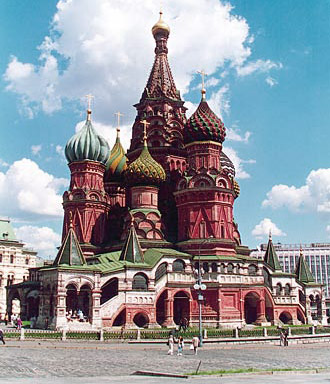 We now visited the singular Church of St. Basil said to have been constructed for one of the Emperors who, after it was finished, tore out the eyes of the artist in order that he might not build another similar for any other monarch. It is a singular [47] building composed of several distinct chapels so arranged that services can be performed in them all at the same time, without the one disturbing the other.
Sunday, September 25, 2011

 |
| Fedor Alekseev and his pupils. The Foundling Hospital in Moscow.1800-1802. Watercolour on paper. The Hermitage, St. Petersburg, Russia. |
Subscribe to:
Posts (Atom)